
Gary Gao ('28), a sophomore in the College and in Wharton, spent this past summer in Professor Marc Miskin's Circuits Lab. There, Gary helped design and prototype a oscillator-based physical learning network, a circuit that can perform AI tasks for a fraction of the energy. This internship gave Gary the opportunity to learn the processes necessary for neuromorphic computing. This experience was supported by the Franklin Opportunity Fund, an internship funding opportunity for Benjamin Franklin Scholars.
Gary Gao – SAS ’28, W’28
This summer, I worked in Professor Marc Miskin’s circuits lab to design and prototype a novel oscillator-based physical learning network – a circuit that can perform AI tasks like regression or classification while using a fraction of the speed and energy of a digital counterpart.
I worked closely with Dr. Marc Miskin, Adam Frim, and other members of the lab, and my role spanned three concrete pieces: formalizing mathematical learning rules, prototyping breadboard circuitry, and presenting results during group meetings.
I didn’t “find” this internship through a conventional search – I’d already been researching in the lab for five months, and I was given the opportunity to continue over the summer.
Coming in, I was excited because the lab had already let me build real momentum. Over the prior semesters I had the chance to research network topologies, program Python interfaces, and help build an end-to-end cloud-computing platform for physical learning, while also developing practical skills like rapid prototyping.
The bigger “why” for me is the promise and peril of AI. As a researcher and developer who is applying AI in various contexts, such as pottery classification or data collection, I understand the benefits that AI can have when used correctly. However, as an ISP student, I also recognize the environmental and social costs that energy-hungry datacenters can have. Developing the next generation of energy-efficient AI infrastructure allows me to bridge this gap and take part in creating a sustainable AI future where we can harness its benefits without absorbing unnecessary harms.
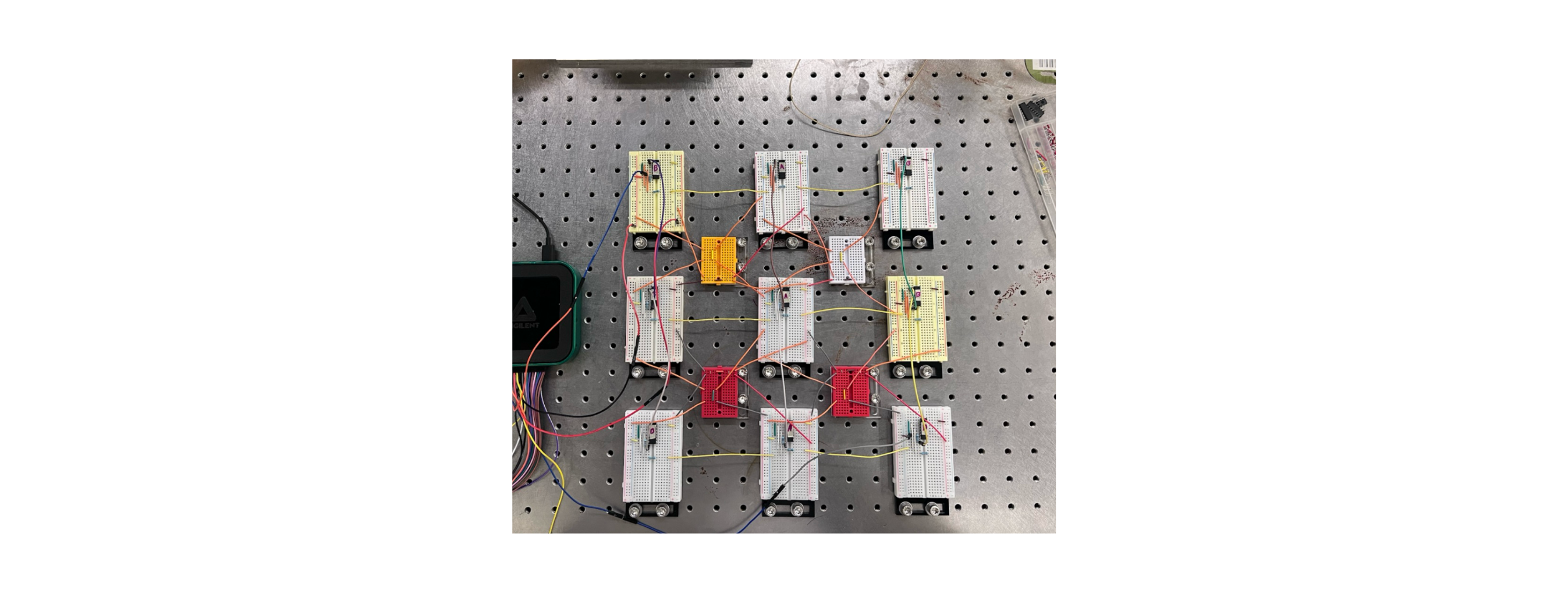
Pictured: A Nine-Node Oscillator Network
Day-to-day, the work followed a disciplined pipeline. We started with background research and formalizing the learning rules, and the first step in these circuit projects was always to validate those rules by simulating them in Jupyter Notebooks. Only after confirming the simulations did we move into hardware – building the oscillators and eventually the learning edges.
Not everything went smoothly, and that was the point. Early on, I tried to move too quickly in the first two weeks and missed some critical waveform tests, which created significant oscillator errors. Catching the issue quickly still taught me the lesson I needed – to verify each step to a high standard before moving on.
I also learned how time-intensive hands-on research can be. Waiting days for parts to arrive, especially when building learning edges that required multiple integrated-circuit components, made it hard to plan for time efficiency while simultaneously building and discovering.
What kept me going was the joy of seeing the circuits learn, and the lab community. Hearing other researchers’ progress every Thursday inspired me and broadened my view of neuromorphic computing.
Going forward, I plan to carry the patience and rigorous testing mindset I gained this summer as I keep developing these physical learning networks, in service of a more sustainable AI future.
Interested in reading more accounts from BFS? Click Here
Related Articles

Learning Through Involvement
Griffin Pitt ('26) reflects on her time at Penn and in the Benjamin Franklin Scholars Program. Griffin was a Benjamin Franklin Scholar and the President of the BFS Undergraduate Advisory Board, an SNF Paideia Fellow, an Environmental Economics Research Fellow at The Water Center, and much more. She writes on the importance in exploring opportunities and experiential learning. Griffin is a recipient of the Thouron Award and is currently at Oxford pursuing her Masters of Science in Water Science, Policy and Management.
Connections and Community
Hannah Shumsky (‘26), a Neuroscience major, conducted research on the effect of circadian rhythms on lung repair and regeneration with mentorship from Dr. Shaon Sengupta (Division of Neonatology, Children’s Hospital of Philadelphia). This research was supported by the College Alumni Society Undergraduate Research Grant.