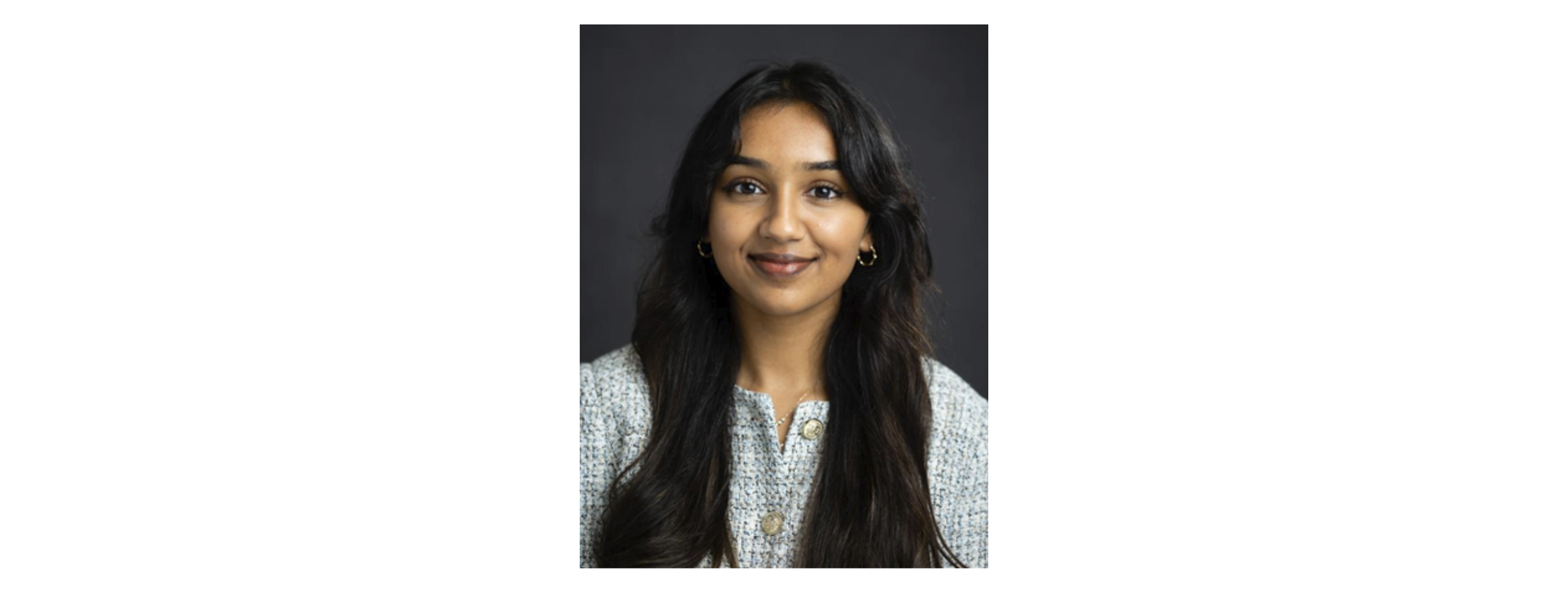
Sneha Chandrashekar (‘27), a Neuroscience major, researched how transcranial magnetic stimulation (TMS) could be improved as a treatment for post-traumatic stress disorder (PTSD). Sneha recently presented her research at the 2025 Society for Neuroscience (SfN) conference in San Diego, CA. She conducted this project with the mentorship of Dr. Nicholas Balderston (Department of Psychiatry) and support from the University Scholars program.
Post-Traumatic Stress Disorder (PTSD) affects nearly 4% of people across the world, yet standard approaches to care, such as psychotherapy, are often ineffective. Transcranial magnetic stimulation (TMS) is a potential treatment that uses non-invasive magnetic pulses to activate or inhibit specific areas of the brain. However, while TMS is FDA-approved for treating depression, obsessive-compulsive disorder, and smoking cessation, it is not authorized for treating PTSD as the optimal target to consistently reduce PTSD symptoms is unknown. This led to my key research question: What parts of the brain should be stimulated to make TMS most effective in treating PTSD?
To address this question, I built a whole brain atlas that links brain connectivity to PTSD symptom severity. I combined computer-simulated maps that illustrated clinical measures of PTSD symptoms, how electrical fields from TMS spread in the brain, and brain connectivity patterns that show how regions communicate with one another. I aimed to understand whether certain brain regions showed a stronger link between stimulation effects and symptom improvement. My analysis identified two broad patterns across the left prefrontal cortex and bilateral parietal and occipital regions that are predicted to reduce symptoms for PTSD. I am currently validating these trends to ensure that other connections were not overlooked during regression analysis.
This was my first time working with complex computational methods, and I had to teach myself how to code and analyze large datasets along the way. Learning to write scripts, troubleshoot errors, and interpret outputs was challenging but rewarding. I remember one particularly frustrating week when a script I was trying to run kept returning nonsensical results, only to realize that a tiny mismatch in data formatting was causing the problem. This taught me the importance of being diligent and visualizing datasets throughout the process.
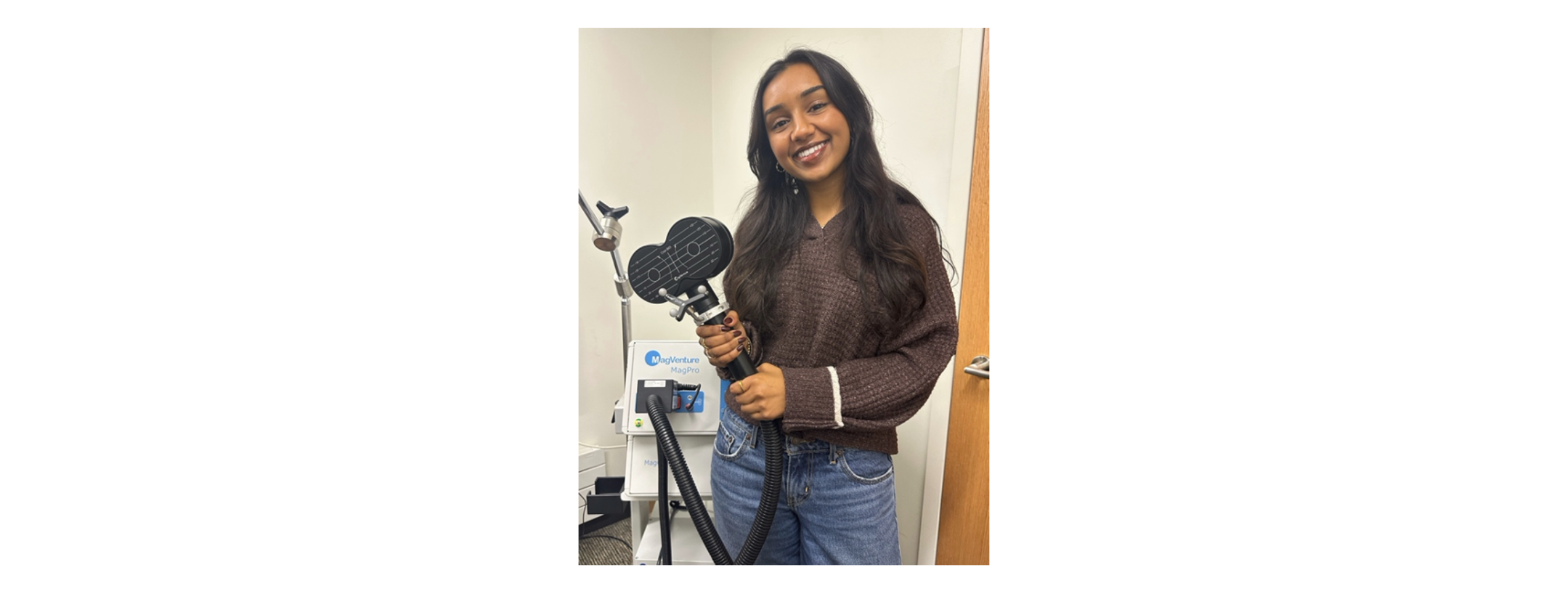
Above: Sneha with the TMS device.
I grew as a researcher, collaborator, and learner from this experience. Working with Dr. Balderston was one of the most rewarding aspects; we met weekly to discuss my progress, brainstorm next steps, and troubleshoot challenges. Whether it was debugging a particularly difficult piece of code or refining the direction of my analyses, he always made sure I felt supported. He assisted when needed but consistently encouraged me to take ownership of the project. In addition to these individual meetings, I participated in our weekly whole-group lab meetings, where I gained a broader perspective on how each team member’s work contributes to advancing TMS treatments. Through these discussions, I learned how to communicate my ideas clearly and see research as a collective effort rather than an isolated task. I also enjoyed working alongside fellow UScholar, Madison Dengel, who created a sense of accountability and camaraderie.
My project culminated in a poster presentation at the 2025 Society for Neuroscience conference, which was an incredibly meaningful experience in my research journey. The questions I received pushed me to think more deeply about how my symptom atlas might generalize to other psychiatric disorders, how head modeling assumptions affect prediction accuracy, and how theoretical TMS targets could be validated clinically. Several attendees asked about incorporating longitudinal data or symptom clusters, which gave me new ideas for future analyses. Their engagement reinforced that this problem sits at the intersection of computational neuroscience, psychiatry, and clinical innovation, and that collaboration across these fields is essential.
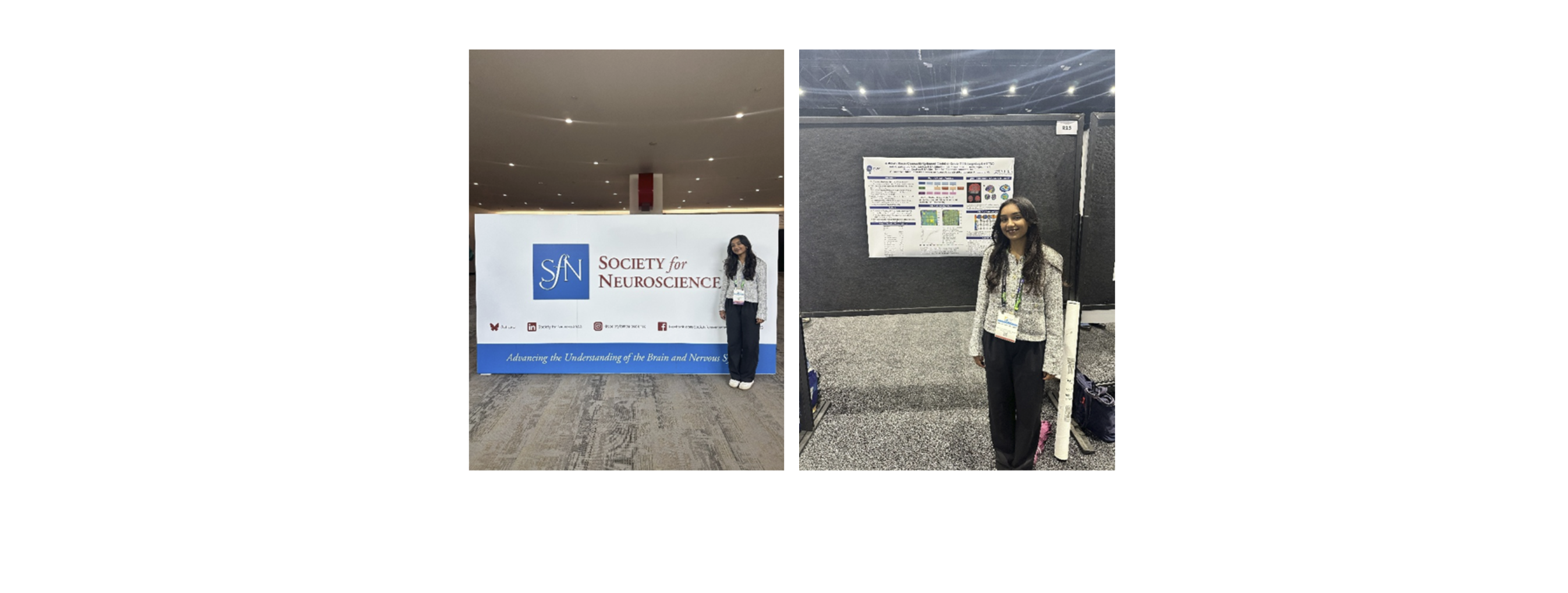
Above: Sneha at the 2025 Society for Neuroscience (SfN) conference in San Diego, CA (November 15-19, 2025). She presented her poster titled, "A whole-brain functional connectivity model to guide transcranial magnetic simulation targeting for post-traumatic stress disorder." Sneha attended SfN with support from the Edell UScholars Endowed Research Fund and the SfN Trainee Professional Development Award.
Over the past several months I developed resilience, diligence, and communication skills. I pivoted when analyses didn’t go as planned, performed quality checks when navigating unexpected data challenges, and tailored project explanations depending on my audience. Overall, these experiences deepened my confidence in pursuing translational research that bridges computational modeling and patient care. It reinforced my interest in combining neuroscience with real-world clinical applications and strengthened my commitment to pursuing a career as a physician researcher who not only treats patients but strives to improve delivery of care.
Interested in learning more about University Scholars? View other UScholars research experiences on our Student News page!
Related Articles

Connections and Community
Hannah Shumsky (‘26), a Neuroscience major, conducted research on the effect of circadian rhythms on lung repair and regeneration with mentorship from Dr. Shaon Sengupta (Division of Neonatology, Children’s Hospital of Philadelphia). This research was supported by the College Alumni Society Undergraduate Research Grant.
The Heart of the Matter: Research at the Penn Cardiovascular Institute
Andi Therese SyCip (‘26), a Biology major, conducted research on how minor genetic alterations to estrogen-relation receptor binding sites impact heart function. Andi was mentored by Dr. Daniel Kelly (Department of Medicine), and this research was supported by Jumpstart for Juniors.