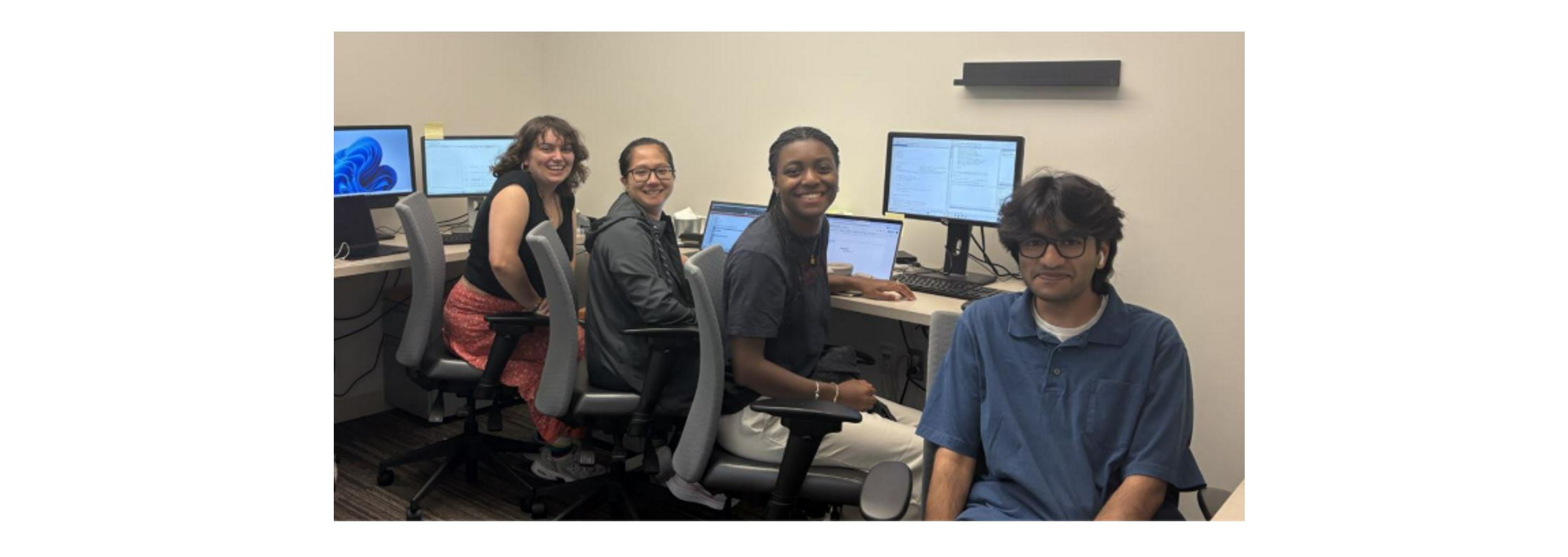
Nicollette Hillman (‘28), Affan Jabbar (‘27), Bria Morgan (‘28), and Sadie Daniels (‘28) conducted research with Dr. Sara Jaffee (Department of Psychology) on the PHLHousing+ Study. In the United States, only one in four households experiencing housing cost burden (defined as spending over 30% of household income on rent) receive rental assistance. PHLHousing+ is a direct rental assistance pilot program designed to address this gap by providing cash payments to 300 Philadelphia families. This research was supported by the Penn Undergraduate Research Mentoring Program.

Reflecting on her research experience, Nicollette, a student in the College of Arts and Sciences, said “This experience pushed me to grow in ways I never expected and helped me connect my interests to real-world impact.”
This study compares families receiving cash or vouchers to a control group receiving no assistance, measuring outcomes related to housing stability, eviction, finances, mental health, and child development using survey data and qualitative interviews. I was drawn to the topic’s interdisciplinary nature, blending social policy, psychology, and other disciplines together while giving me the opportunity to explore housing more deeply. The topic is also personally meaningful. Growing up in a low-income household and attending a Title I elementary school, I saw firsthand how housing insecurity affected classmates’ academics, health, and well-being. Through working on PHLHousing+, I learned about housing in Philadelphia and how it impacts people’s lives. It opened my eyes to the current gaps in rental assistance and the need for more equitable access to affordable housing.

One piece of research advice from Affan, a Sociology and Economics double major, is “Take it slow when joining a lab–while it may be tempting to jump into big projects, the foundational tasks like data cleaning and survey outreach are equally important and essential for truly understanding and conducting research.”
I was particularly drawn to the interdisciplinary nature of the study, which examined the effects of assistance not only on housing and financial outcomes but also on family well-being and health. Over the summer, I gained valuable insights into the research process and the extensive work involved in collecting, cleaning, and documenting both quantitative and qualitative data. I developed a range of technical skills, including analyzing data in STATA, conducting interviews, and coding them in Dedoose, as well as transferable skills such as effective communication, independence, and collaboration with my fellow research assistants. This experience strengthened my interest in housing and social policy and affirmed my commitment to continue engaging with these issues through research.

One of the biggest takeaways for Bria, an Economics major, from this research experience was that “Even the menial tasks are meaningful when doing research!”
I chose this project because it offered me the opportunity to develop technical skills, but I genuinely learned so much more. Although I tried to thoroughly explore Penn and Philly during my freshman year, this summer provided me with the opportunity to engage with a number of different communities throughout the city. My peers shared their thoughts about Penn in general, from what classes to take to great food spots. Through my mentor and other project leaders, I gained valuable insights into the research process and graduate school. From interacting with the research participants, I learned more about various neighborhoods and experiences in Philadelphia. Additionally, the culture within the PHLHousing+ program was amazing. Despite being very new to the project and having almost no expertise, my thoughts and opinions were valued and carefully considered.

Reflecting on her research experience, Sadie, a student in the College of Arts and Sciences, said “Through local interviews and fieldwork, I was able to learn more about Philly than ever before.”
During this research, I learned more about my interests within the field of urban planning and have become especially drawn to the housing sector. Additionally, I gained both new qualitative and quantitative research skills like STATA, coding, and how to hold interviews. This research project has allowed me not only to learn more about current policy, but also to begin to envision ways it can change. At times of economic turmoil, there is an acute need for city planners to focus on developing both short- and long-term policy changes. This includes life-changing programs like PHLHousing+. Seeing how policies like this have changed the lives of families, I’ve begun to further orient myself towards a career in public policy and urban change.
Interested in reading more first-hand accounts about undergraduate research? Check out the other experiences featured on our Student News Page and Social Media!
Related Articles

More Than Just Robotics Research
Jeffrey Oduman (‘28), a Computer Science major, conducted robotics research with mentorship from Dr. Cynthia Sung (Department of Mechanical Engineering and Applied Mechanics). This research was supported by the Penn Undergraduate Research Mentoring Program.
When Voices Become Meaning
Ethan Yang (‘27) is a Mechanical Engineering and Applied Mechanics major currently pursuing a submatriculated Master of Science and Engineering (MSE) in Robotics. He conducted research on how humans interpret and perceive AI-generated audio with mentorship from Dr. Jianjing Kuang (Department of Linguistics). This research was supported by the Penn Undergraduate Research Mentoring Program.